Showing posts with label honu. Show all posts

Friday, June 6, 2014

Saturday, May 3, 2014

Friday, April 4, 2014

Hitchers

Photo Copyright 2014 by Barry Fackler


A few years ago, I encountered a large male green sea turtle (Chelonia mydas) swimming through Honaunau Bay with white masses on his shell. Initially, I thought these might have been fibropapillomas that sometimes afflict sea turtles. Upon closer inspection, I saw that the masses were gooseneck barnacles (Pollicipes polymers) a type of sessile crustacean that can often be seen attached to pilings, docks and boat hulls.


Photo Copyright 2014 by Barry Fackler


George Balazs, NOAA's sea turtle biologist in Hawai'i, explained that barnacles tend to grow on green sea turtles that remain out in the open sea for prolonged periods of time. Most greens spend their time near shore except when traveling to and from their mating grounds.


Photo Copyright 2014 by Barry Fackler


After the turtle came to rest, I found another creature hitching a ride - this slender remora (Echineis naucrates).

Over the years I've seen a lot of turtles but this was the first I've ever seen with barnacles and  one of only a handful I've seen with a remora. I guess this turtle continued his seafaring ways because I never saw him again.

Thursday, March 13, 2014

Wednesday, March 12, 2014

Big Sky

Photo Copyright 2014 by Barry Fackler
green sea turtle               Chelonia mydas

Thursday, March 6, 2014

Uprising

Photo Copyright 2014 by Barry Fackler


green sea turtle          (Chelonia mydas)

Thursday, February 20, 2014

Monday, February 3, 2014

Bunkmates

Photo Copyright 2014 by Barry Fackler

This photo shows a green sea turtle (Chelonia mydas) sharing its resting spot with a whitetip reef shark (Triaenodon obesus). As mismatched as this arrangement may seem, I've actually seen it several times and I imagine it must be fairly common. Both species like to shelter under ledges or in lava tubes during the day and, since such places are in short supply, inter-species co-habitation sometimes occurs. This type of shark has small teeth and feeds on small reef fishes and invertebrates so the turtle is not in peril.

These species like to shelter in tight spaces so getting a pleasing photo of both creatures is difficult. Hence, the shark's face being obscured. 

Monday, February 18, 2013

I Won! I Won! I Won!

Photo Copyright 2013 by Barry Fackler

The Photo above won the SeaLife Camera Photo of the Month contest. My prize is a SeaLife Mini II camera. I'm pretty happy because I don't usually win contests. Just thought I'd share. Have a nice day!

Tuesday, January 24, 2012

Barry Fackler In the News

Recently, a couple of my photos were featured in the "Island Life" section of our local newspaper, West Hawai'i Today.  For me, a small but pleasant thrill knowing that a photo editor out there likes an image I took with my dinky little point-and-shoot camera. For those of you who don't receive WHT, here are the photos.


Thursday, August 18, 2011

Saturday, August 28, 2010

Thursday 8/26/10

Photo Copyright 2010 by Barry Fackler

First Dive of the Day...

Phoyo Copyright 2010 by Barry Fackler

...Second Dive of the Day!

Life (and diving) is good in Hawai'i!

Monday, August 16, 2010

Turtle Portraits


Photo Copyright 2010 by Barry Fackler

I got a new camera recently and am still having trouble getting the "feel" for it. What I'm learning is that it is pretty poor at focusing on anything that happens to be moving! Not a good thing for underwater photography. Anyway, to get some decent photos, I've been going to the turtle beds early in the morning to get some close-ups of the honu while they're still being still. I've gotten a few good results, these being the best.

Photo Copyright 2010 by Barry Fackler

Photo Copyright 2010 by Barry Fackler

Photo Copyright 2010 by Barry Fackler

Photo Copyright 2010 by Barry Fackler

Saturday, May 8, 2010

Dive Report for Saturday 05/08/10

A rather drab and overcast day, weather-wise but the ocean conditions were pretty good with only a tiny bit of surf. It was one of those days when things just didn't seem to go right. My strobes, which worked perfectly on the pre-dive check, were incredibly frustrating while I was underwater. The right strobe failed totally and the left strobe only worked about a quarter of the time. Very gratifying, especially since it was too overcast to shoot with ambient light. Of course, when I got home they worked perfectly.

Photo Copyright 2010 by Barry Fackler
You can tell I might have had a bad day when my lead-off photo is this Iridescent Cardinalfish. Pretty drab but this is probably the best photo I have of one as I don't do much night diving. It was so overcast this morning that a lot of these were out.


Photo Copyright 2010 by Barry Fackler
This honu was very mellow and hung around me for a long time which favored my 1 out of 4 or 5 successful strobe ratio.


Photo Copyright 2010 by Barry Fackler


Photo Copyright 2010 by Barry Fackler
Even though green sea turtles are easy to come by, this girl was the high point of this morning's dive. The low light kind of worked well giving some extra contrast to the wide angle captures.


Photo Copyright 2010 by Barry Fackler

This Yellowmargin Moray was sticking straight out of a small wall near the shoreline. It was a little shy but I managed to get this one useable photo.

Photo Copyright 2010 by Barry Fackler
These two Longenose Butterflyfish were caught picking at the coral in unison.

Photo Copyright 2010 by Barry Fackler
This Threadfin Butterflyfish is still sporting its muted "night-time" color scheme with the white portions slightly dulled. Again, perhaps due to the darkness of the day.

I have a spare flash unit in storage that I put there because it wasn't working properly. I'm going to use it to replace my current right strobe and hopefully will get more flashes out of it.

Hopefully, next week I'll have more and better material to offer you!      Aloha

Sunday, March 21, 2010

Dive Report for Sunday 03/21/10

The surf was really up this morning! I took this photo with my cell phone and it shows big waves slapping the lava flow that extends seaward from the national park at the southern end of the cove. There was big surf to the north as well, but inside the cove conditions were manageable and visibility was OK. Water temp is still hovering at ~74 degrees.


Photo Copyright 2010 by Barry Fackler
Early in the first dive I found this Bullethead Parrotfish scraping algae from the coral. You can clearly hear the beak scraping the rock-hard surface. The fish ingests the calcium carbonate "skeleton" of the coral and (very) shortly thereafter poops it out as beach sand.


Photo Copyright 2010 by Barry Fackler
This little male Spotted Boxfish kept me entertained for awhile. It's body is covered with hexagonal plates and is fairly rigid. Nevertheless it is quite nimble and surprisingly fast for a creature that is as streamlined as a box!


Photos Copyright 2010 by Barry Fackler
I resisted the temptation to photograph another octopus that I found today. After all, how many octo photos does one blog need? I have a much harder time ignoring honus. This one was extremely mellow, swimming right along with me for a few minutes before rising to the surface for air.


Photo Copyright 2010 by Barry Fackler
I caught this Hawaiian Dascyllus being given the once over by a Hawaiian Cleaner Wrasse. In this photo the wrasse is oriented so his "back" (dorsal surface) is facing the camera.


Photo Copyright 2010 by Barry Fackler
On the second dive, I saw this Moorish Idol. This one is a small adult. It used to have a partner with it but now seems to be going solo.


Photos Copyright 2010 by Barry Fackler
This funny little fish used to be called a Leopard Blenny. Later, the common name was changed to Shortbodied Blenny. This year it's called a Spotted Coral Blenny. Some species of fish are doomed to have an identity crisis created by fickle fish fanciers! They usually sit out in the open but seem to freak out the nano-second you make eye contact with them. They frantically dive down into the coral and erratically and quickly do a series of quick peeks at you before disappearing for good. This one was an exception, allowing me to take several photos which I am very happy to share.


Photo Copyright 2010 by Barry Fackler
Another little treat was this Jeweled Anemone Crab. Like all hermit crabs it inhabits a snail shell for protection. But this kind goes a step further by attaching anemones to its shell. When disturbed, the anemones eject bright pink stinging filaments called acontia. This gives the crab an additional line of defense. Nature is awesome.


Photo Copyright 2010 by Barry Fackler
My last photo for this post is the lowly and under-appreciated Hawaiian Sergeant. Plain and common it doesn't get much attention. I've been giving the species a little more attention as thy are cooperative photo subjects.

That's all for now, folks. See you next time!

Sunday, March 14, 2010

Dive Report for Saturday 03/13/10


The morning sun shone warmly on Hale O Keawe and the glistening waters of Keone'ele Cove .Still can't believe the luck we've been having this winter (I know, It's now "officially" spring). Anyway, the surf was way down on Saturday and diving conditions were epic once again.
Photo Copyright 2010 by Barry Fackler
This was an unusually cooperative Stocky Hawkfish. Usually, they dart for cover as soon as your eyes turn in their direction. More than one diver I know calls them "army fish" because of their effective camouflage pattern and colors. this one was fairly mellow, letting me crank off four shots before he headed for cover.


Photo Copyright 2010 by Barry fackler
In the shallows I saw a mixed school of Raccoon, Threadfin, and Lined Butterflyfish. Initially they were hanging in the water column but soon settled on the reef to feed. In the photo above, a Lined Butterflyfish grazes among the coral. These are the largest butterflyfish in Hawai'i and are not common.


Photo Copyright 2010 by Barry Fackler
Here, some of the Threadfins linger in the water column. Some of the Threadfins in Keone'ele Cove must have been fed by divers or snorkelers because they occasionally approach quite eagerly.


Photo Copyright 2010 by Barry Fackler
I caught another Spotted Puffer napping on the coral this AM. These fish vary greatly in color and pattern. They can be dark or light and have a few large spots or many small spots. All of them have bristly skin which gives them the nickname "velcro puffer".


Photo Copyright 2010 by Barry Fackler
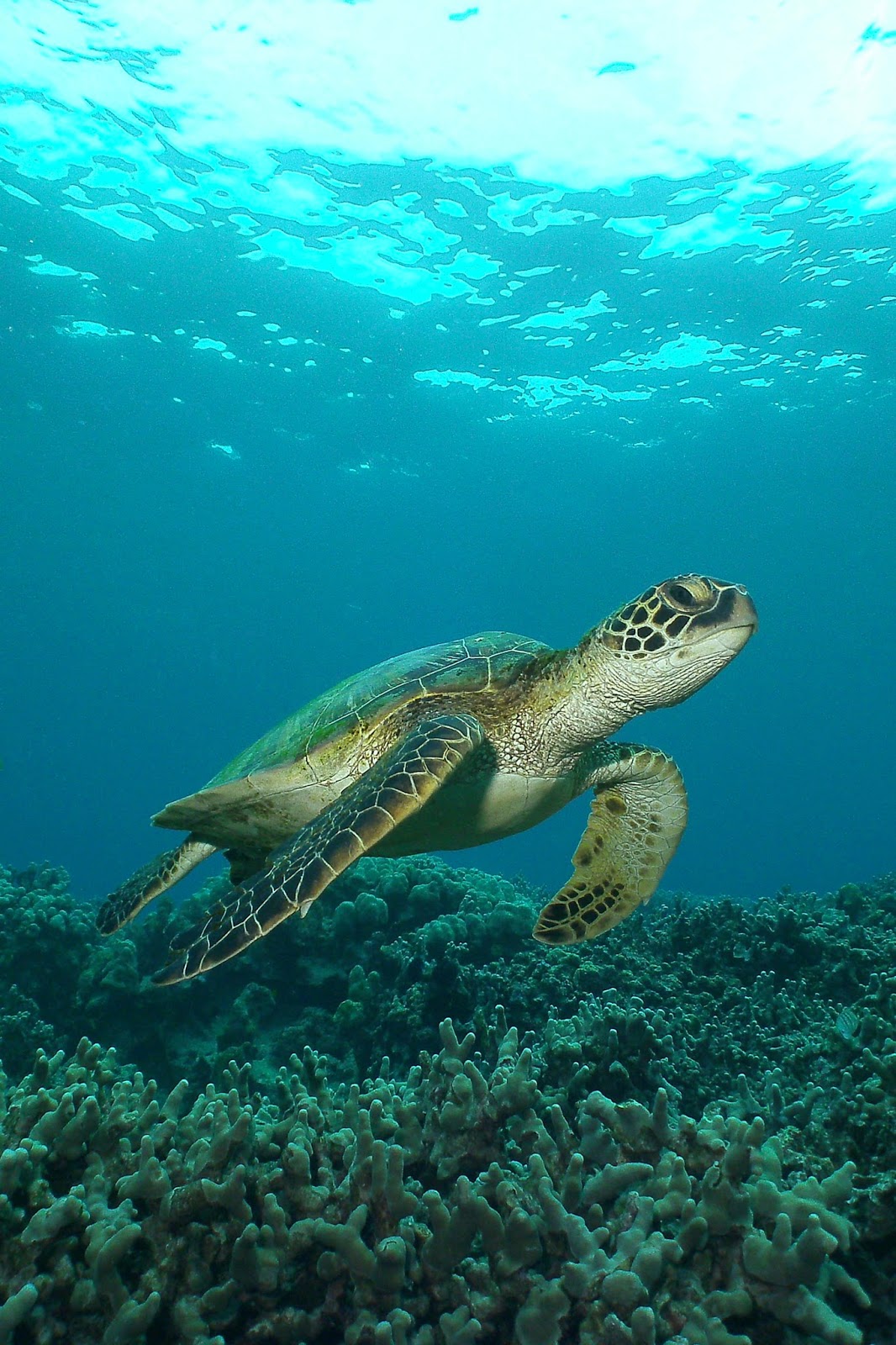
Puffers weren't the only creatures caught napping. This old honu was resting beneath an overhang of coral. Before long, he stretched his flippers and started to swim about the reef.


Photo Copyright 2010 by Barry Fackler
I snapped this photo just as the honu raised his head for a breath of air. I'm not wild about the composition of the photo but I love the colors. This was at the end of my first dive.


Photo Copyright 2010 by Barry Fackler
This Spotted Eagle Ray may have been following me for awhile on my second dive. I caught a glimpse of him out of the corner of my left eye. When I turned to look in his direction, he started to pull away into the blue. There was no point in following as he seemed a little skittish and unlikely to give much in the way of photo ops.


Photo Copyright 2010 by Barry Fackler
Despite the surge, I stuck my head in the swim-through to check on the little Ambon Toby I saw last week. It's still in there and looking pretty good.


Photo Copyright 2010 by Barry Fackler
I did see another octopus on this dive. This one was a bit shier than most so, I let it be. Over the past few weeks I've amassed quite a few octo photos, anyway.


Photo Copyright 2010 by Barry Fackler
This sand-dweller is a Clearfin Lizardfish. Except for the tail, all its fins are transparent. When it is not partially buried in the sand, it looks very much like a stubby snake.


Photo Copyright 2010 by Barry Fackler
I saw a few supermale Belted Wrasse like this one on my second dive. This is a really pretty fish with a bright orange "belt" bisecting multiple hues of green. Unfortunately, like most wrasse, they are very fast and flit about erratically so I have very few decent photos of them.


Photo Copyright 2010 by Barry fackler
My last dive photo for this post is of the common Hawaiian Sergeant. Sergeants are a type of damselfish and are common at tropical and semi-tropical dive locations around the world. They have a common shape and most have black bars on the sides. They form loose schools and are often overlooked as "background fish".


This is a photo of one of my most beloved pieces of dive gear, my '98 Jeep Cherokee Sport. For 10 years it has transported Betty and I, as well as numerous guests to adventures all along the coast. The decade has been rough on the machine and it is now rusted and showing signs of mechanical wear and tear that would be impractical to repair. I have to decide in the next month if I'm going to invest the money in it to make it able to pass the upcoming safety check. It needs 4 new tires and some electrical work at the very least. It also tends to overheat if I drive it to town and back. The latch that shuts the rear has corroded away and I have to close the hatch with bungee cords. Classy, huh? Just a little reminder that this diving lifestyle isn't all glamor!

Til' Next Time, Aloha