Showing posts with label Commerson's Frogfish. Show all posts

Sunday, May 17, 2015

Commerson's frogfish seen at Honaunau


A few months back I encountered this medium-sized Commerson's frogfish (Antennarius commerson) at the north end of Honaunau Bay. I was able to get some decent photos including this one of it swimming.


Frogfish aren't built for swimming but are wondrously well adapted for sitting still, so to see this one swim for a short distance was interesting. While sorely lacking in either speed or endurance, the frogfish has an ingenious form of propulsion wherein it forces jets of water from ducts under its "arms" (pectoral fins) to give it an extra boost.


Also kind of cool (to me) is this final shot where you can see the thin spine sprouting from the forehead with a bushy "lure" at the end. The lure is called an esca and is jiggled by the frogfish to lure unsuspecting prey close to its generously-sized mouth. And thus, the Circle of Life remains unbroken.  Hakuna Matata!

Monday, February 25, 2013

Good Things in Small Packages

This past Saturday there was a n outrigger canoe race launching from my favorite dive spot, Honaunau Bay. This was the first weekend in quite a while where the surf was fairly calm and I felt I needed to get in the water. I decided to go to Keauhou Bay, hoping to photograph the big manta rays that frequent the area. Alas, that was not to be, the mantas apparently being elsewhere engaged. On the return leg of my second dive I glimpsed a bright yellow blob on a piece of coral rubble. The blob turned out to be a tiny, juvenile Commerson's frogfish (Antennarius commerson).


All Photos Copyright 2013 by Barry Fackler
While it doesn't look camouflaged, this little fish is closely mimicking a local sponge species. Eventually, this inch-long individual will grow to about a foot in length and resemble an algae, sponge and coral-encrusted rock on the sea floor.

Tuesday, January 24, 2012

Barry Fackler In the News

Recently, a couple of my photos were featured in the "Island Life" section of our local newspaper, West Hawai'i Today.  For me, a small but pleasant thrill knowing that a photo editor out there likes an image I took with my dinky little point-and-shoot camera. For those of you who don't receive WHT, here are the photos.


Friday, August 12, 2011

Commerson's Frogfish, juvenile


I've been seeing this juvenile Commerson's Frogfish for the last three weekends now. It's a pretty big juvenile (about five inches long) and I suspect it will be losing its bright yellow coloration and gaining less conspicuous camouflage. It has been very cooperative for photographs and stays in the same general area.


All Photographs are Copyrighted 2011 by Barry Fackler

Wednesday, June 2, 2010

Dive Report for Saturday 05/29/10

Saturday was a great day for diving with a flat sea and crystal clear water. It was not, however a great day for photography as both SeaLife strobes decided to act up! About 60% of the time NEITHER strobe fired, resulting in a lot of missed shots. Fortunately, the sheer volume of shots I took resulted in some decent photos. It is supremely frustrating to get in perfect firing position with a skittish subject abiding in a hostile environment only to be foiled repeatedly by technical failure. I was doubly fortunate in that we had plenty of Spinner Dolphins on both dives which gave me plenty of ambient light photo ops.


  Photo Copyright 2010 by Barry Fackler

When Betty and I first arrived at Honaunau Bay (a little after 7 AM) the dolphins were rising and spouting in unison. This was something we don't see very often and it was neat to observe.

Photo Copyright 2010 by Barry Fackler

The wonderful thing about SCUBA is the chance to have dolphins above, below and beside you for extended lengths of time.

Photo Copyright 2010 by Barry Fackler

Notice the little nicks on the trailing edge of the dolphin's dorsal fin in the photo above. I wonder how they got there? It doesn't look to be the work of Cookie-Cutter Sharks.

Photo Copyright 2010 by Barry Fackler

These three males travelled together and swam close to us repeatedly. You got the impression that they were protectors of the pod and would take action if we made any threatening moves.

Photo Copyright 2010 by Barry Fackler

Photo Copyright 2010 by Barry Fackler

The dolphins stayed the entire morning and drew quite the appreciative crowd of snorkelers, kayakers and shore observers.

Photo Copyright 2010 by Barry Fackler

As much as I love dolphins, I can't spend a whole dive watching them. I was anxious to see if my little yellow frogfish was still where I left him last week. Sure enough, I was able to locate him (or her) in less than a minute after arriving in the area.

Photo Copyright 2010 by Barry Fackler

I hope this fish stays in the same area for a long time so I get a chance to see it change over time. As it matures, its appearance will change as its color and texture will mimic its surroundings.

Photo Copyright 2010 by Barry Fackler

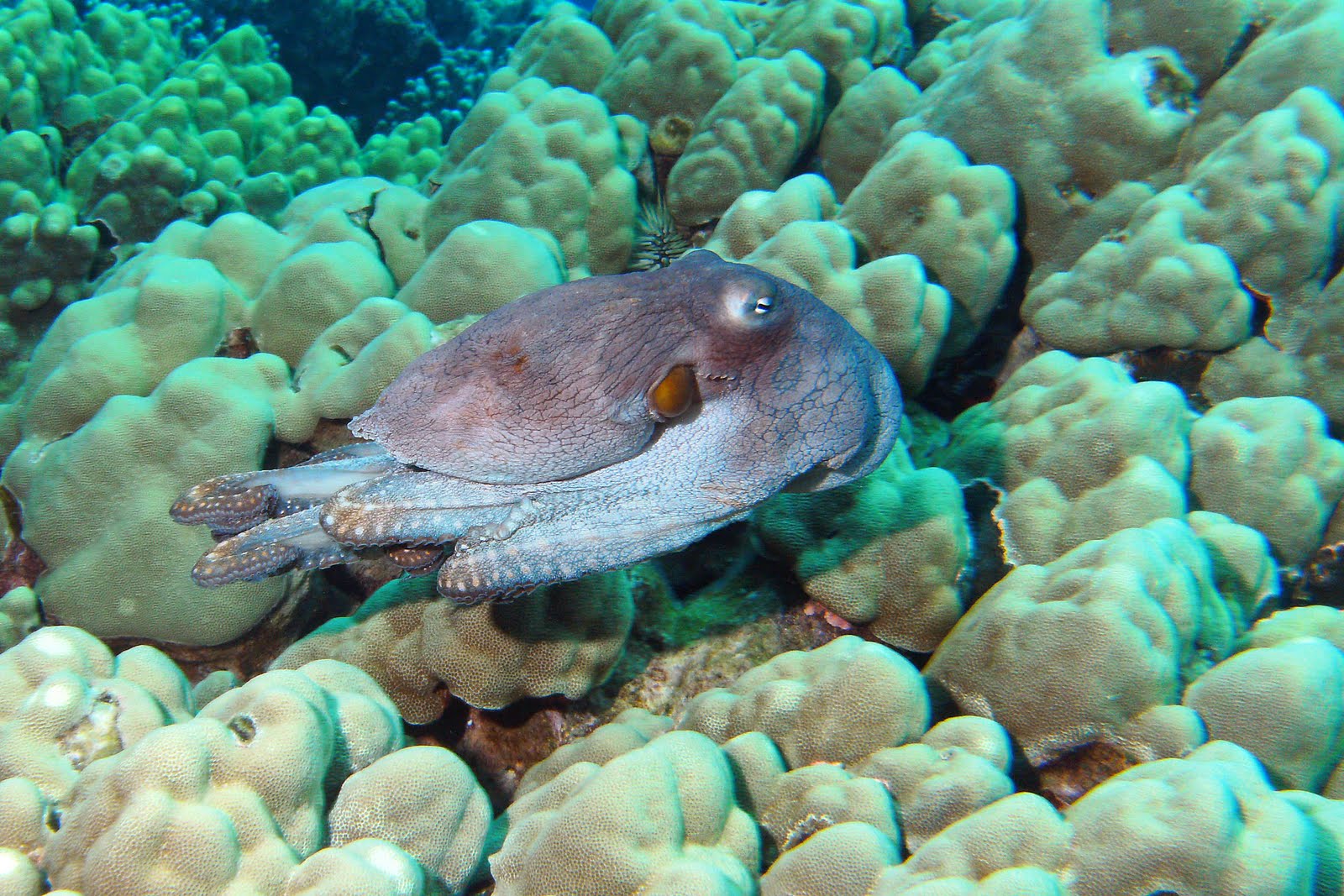
Over the course of two dives, I saw four different octopi. Two were in close proximity to one another and may have been thinking about making a few hundred baby octopi. I could have gotten a few hundred good photos if the strobes had been co-operating! 

Photo Copyright 2010 by Barry Fackler

Photo Copyright 2010 by Barry Fackler

When the octopus decides the encounter is over, the encounter is over ! And when this blogger is out of photos, this post is over as well. 

Aloha!

Monday, May 24, 2010

Dive Report for Saturday 05/22/10

 Photo Copyright 2010 by Barry Fackler
A mild swell and gloomy skies greeted divers at Honaunau this past Saturday. For my first dive, I descended right off the "ALOHA" to visit the Longfin Anthias on their little coral head. I like to shoot photos of them every now and then trying out different approaches and angles.


Photo Copyright 2010 by Barry Fackler
The male remains as bold as ever and the females are getting less shy as well.


Photo Copyright 2010 by Barry Fackler
This female was feeding on some organic matter in the water column. It's not the greatest photo, but I like that it shows the fish with its mouth open ready to eat.


 Photo Copyright 2010 by Barry Fackler
I caught this group of Yellowfin Goatfish being groomed by a Hawaiian Cleaner Wrasse.


Photo Copyright 2010 by Barry Fackler

I rarely can get a photo of a Yellowtail Coris as they move so swiftly and erratically. This time I was fast enough.


Photo Copyright 2010 by Barry Fackler

When I get a little frustrated trying to photograph fast-moving fish, I take a break and shoot something that moves really slowly, like this Needle-Spined Sea Urchin.

Photo Copyright 2010 by Barry Fackler

On the second dive I came across this Juvenile Commerson's Frogfish. This is the second one I've seen this month. Maybe there's a population boom going on. This one was sitting right out in the open in a field of rocks.


Photo Copyright 2010 by Barry Fackler


Photo Copyright 2010 by Barry Fackler

Photo copyright 2010 by Barry Fackler

My report ends with this head-on shoy of a small Whitemouth Moray nestled in the coral. Have a nice week!

Saturday, April 24, 2010

Dive Report for Saturday 04/24/10


Photo Copyright 2010 by Barry Fackler
The diving at Keone'ele Cove ("Two-Step", Honaunau) was pretty good today despite surge and occasional sets from a northwest swell. Visibility was about 50 to 60 feet on the reef with pockets of better clarity here and there. The south side of the cove had some fair-sized surf rolling in so I decided to head north for my first dive. Had some good photo opportunities for some butterflyfish like the Ornate above and the Pyramids below.


 Photo Copyright 2010 by Barry Fackler

At the point where I was about to turn around and start my return leg of the dive, I caught sight of a creature seldom seen at this locale, a Hawksbill Sea Turtle.

Photo Copyright 2010 by Barry Fackler

This particular Hawksbill was a small female that was only around a foot and a half in length. She stayed very close to the bottom the entire time I observed her, grazing on algae every so often.

Photo Copyright 2010 by Barry Fackler

You can get an idea of her small size from the coral formations nearby. Hawksbills differ from Green Sea Turtles primarily in the shape of their heads. The front of a Green's face is very blunt and almost vertical, whereas a Hawksbill's is tapered like a bird's beak (or maybe a hawk's bill!).

Photo Copyright 2010 by Barry Fackler

Hawksbills are not truly rare in Hawai'i but occur much less frequently than Greens which seem to be present at almost every beach. On the southeastern side of the island is a Hawksbill nesting site at Punalu'u Black Sand Beach.


Photo Copyright 2010 by Barry Fackler

I hung out with my reptilian acquaintance until my air supply encouraged me to be on my way.      I snapped this photo of a Banded Sea Urchin on my way back to the Two-Step.

Photo Copyright 2010 by Barry Fackler

For my second dive I decided to take a chance on going south even though it looked kinda dicey. I was glad I did! Early in the dive I found this cute little baby Commerson's Frogfish clinging to the side of a coral head. Juveniles are almost always bright yellow like this, mimicking a type of local sponge. When they get older, their colors change to match their surroundings and they become quite difficult to see.


Photo Copyright 2010 by Barry Fackler

I took many photos of this fish but few turned out very well. Either I "blasted" it with the strobes and washed out the image or I lost the fish in shadows. I did get a good exposure of it in this photo with his mouth wide open in a "yawn".

Photo Copyright 2010 by Barry Fackler

This Spotted Eagle Ray was making the rounds to all the little sand patches using its nose to shovel up invertebrates to munch. While these rays are majestic to behold while swimming, they have a somewhat ugly face that looks like a squashed duck with snake-like eyes.

Photo Copyright 2010 by Barry Fackler

The last photos for this diving day were of this feisty little Whitemouth Moray. It was free-swimming when I first saw it, but quickly took up shelter under this overhang.

Until next week, gang! A hui hou!


Saturday, November 28, 2009

Commerson's Frogfish


Photo Copyright 2009 by Barry Fackler


This fantastic fish fits into the "common, but seldom seen" category of marine life. They can be found on any reef in Hawai'i if you are lucky enough to be looking in the right spot at the right time. This one happened to be standing out against the blue waterscape behind it. Usually, they are nestled into the reef where their camouflage renders them almost invisible.


Frogfish are sedentary ambush predators that lie in wait on the reef. A specially modified spine dangles a small "lure" directly in front of the cavernous mouth. When a small fish comes to investigate, it is sucked in by a sudden opening and closing of the jaws which takes only 6 milliseconds to complete. The lure is visible in the photo below.


Photo Copyright 2009 by Barry Fackler

Frogfish are very poor swimmers but get a little assist from a jet propulsion system that nature has provided them with. Again, they can suck in a large volume of water through the mouth, then expel it through small gill openings set about midway along the body.


Frogfish blend in well with their surroundings and, as such, can be found in a variety of colors. This particular specimen adapted to the purple-grey hue of the Leptolyngbya algae that has become very common in Honaunau over the last couple of years. In the first photo, a blob of this algae is visible on the left side of the photo between the coral and the body of the fish. We have seen red, yellow, tan, and brown frogfish at Honaunau. Juveniles are usually bright yellow and mimic a common variety of sponge.


Photo Copyright 2009 by Barry Fackler

The pectoral fins of frogfish are uniquely adapted to serve the roles of hands and feet, allowing the fish to stand upon the reef and even to grasp on to the coral. In the photo directly above you can see that these fins terminate into what appear to be stubby fingers.


Finding one of these is doubly gratifying. First, there is the satisfaction of finding the critter despite its extensive camouflage. Second is being able to appreciate the incredible adaptations that allow it to survive.