Showing posts with label manta ray. Show all posts
Friday, May 15, 2015
Fresh Manta Ray Pics from Keauhou Bay
I haven't posted for a while over concerns that my photos were showing up on the internet in places I never intended them to be. As a result, I am now putting the copyright directly on the photo instead of putting it in the caption. I hate to be so petty but, even with my relatively unsophisticated equipment, it takes a lot of time, preparation and effort to obtain these photos and I don't enjoy others taking them as their own work. 'Nuff said.
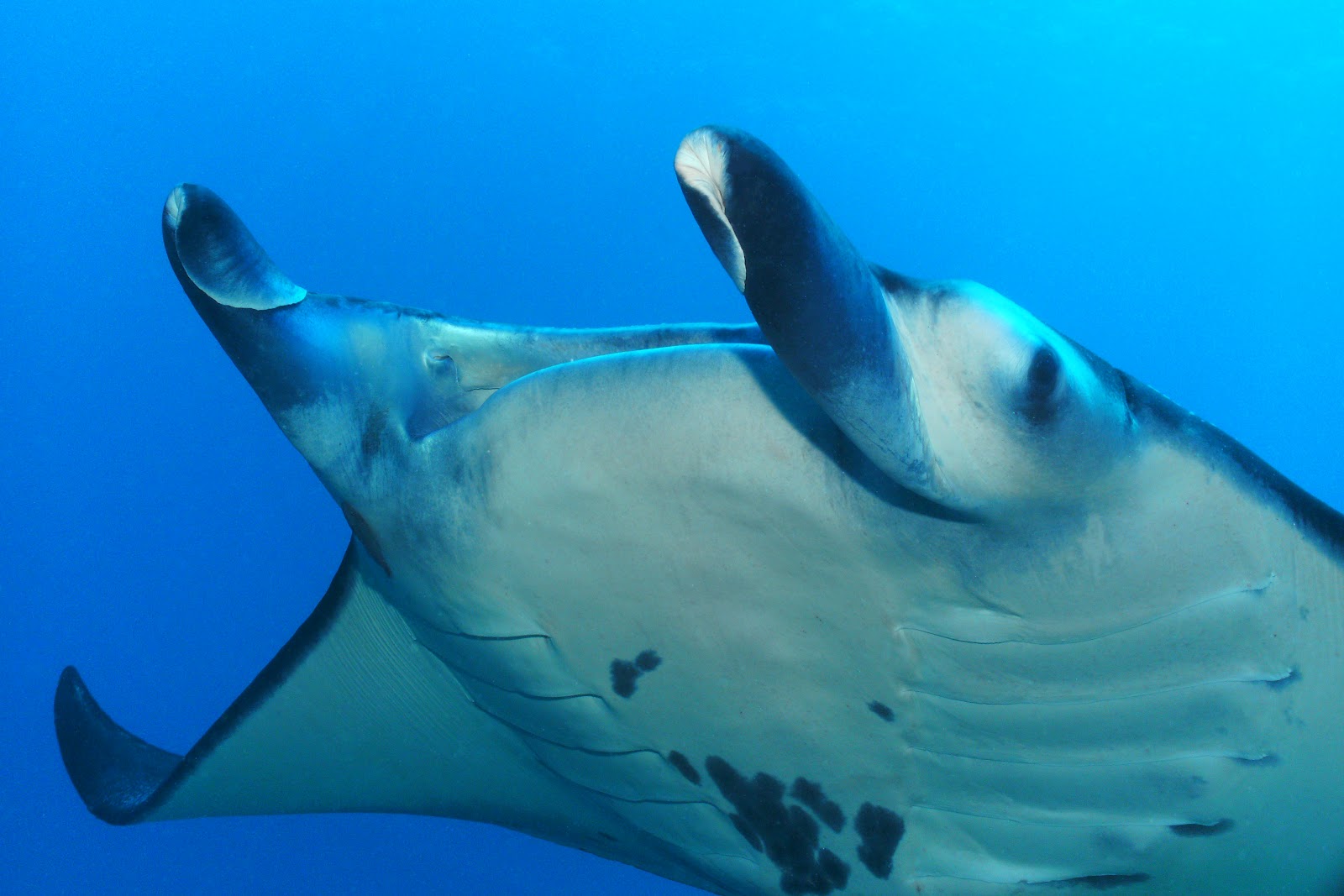
The winter swells are subsiding and I recently made a sojourn to lovely, if somewhat busy, Keauhou Bay to commune with the manta rays. Fortune favored me as I saw three different mantas over the course of two dives. I also saw a sandbar shark but only briefly and from a distance.
As usual, the mantas were present to be cleaned by the various wrasses but they seemed to take longer to "settle down" to be cleaned. Perhaps they haven't had many daytime divers around during the winter and they weren't used to having company.
Nevertheless, it was a good time and I returned with some satisfying photos to share. Conditions were fair with a higher than average amount of marine "snow" making photography a bigger challenge.
Betty and I witnessed some huge surf roll into Keauhou Bay this past winter but the reef seems in good shape compared to Honaunau which took a huge beating.
Well, that's all folks! Mahalo for stopping by.
Labels:
Barron Fackler,
Barry Fackler,
Big Island,
devilfish,
diving,
fish,
hahalua,
Hawai'i,
keauhou bay,
Kona. Big Island,
manta birostris,
manta ray,
marine biology,
nature,
scuba
Location:
Kahaluu-Keauhou, HI, USA
Friday, May 31, 2013
Kailey
Our last big surf of the season has come and gone (hopefully) and we now have consistent calm sea conditions all along the Kona Coast. When the sea gets flat like this I like to get away from Honaunau and check out some of the bays and beaches that are usually more exposed to the surf.
On Memorial Day, I ventured down to Keauhou Bay to see if I could find some mantas to swim with me. I was lucky and found two! By far the more social of the pair was Kailey, the one pictured here. She remained very calm and collected as I settled into her orbit of the cleaning stations on the south side of the bay.
![]() |
| Photo Copyright 2013 by Barry Fackler |
![]() |
| Photo Copyright 2013 by Barry Fackler |
Kailey was named by the diver who first reported her existence to the Manta Pacific Research Foundation (MPRF). The great folks at MPRF identified her for me when I e-mailed them a photo. They do a wonderful job of monitoring the manta ray dive operations along the Kona Coast and have established guidelines for dive operators who offer Manta Night Dives. MPRF has also been instrumental in getting legislation passed to protect the resident manta rays of Hawai'i from fishing and capture for public aquaria.
![]() |
| Photo Copyright 2013 by Barry Fackler |
Unfortunately, the ocean is an untamed environment and no organization can protect every manta from the countless hazards out there. Kailey is missing her entire left cephalic lobe. This is the fin-like extension that forms one of the manta's "horns". When unfurled, these lobes funnel plankton into the mouth during feeding. Fortunately, Kailey's injury is well-healed and she appears well nourished as well. Hopefully, she'll be around to delight divers and snorkelers for a long time to come.
Labels:
2013,
Barron Fackler,
Barry Fackler,
Big Island,
diving,
Hawai'i,
Keauhou,
keauhou bay,
kona,
manta,
Manta Pacific Research Foundation,
manta ray,
scuba
Location:
Kahaluu-Keauhou, HI, USA
Wednesday, March 6, 2013
The Manta's Shadow Part VI - the Festo Air Ray
The manta ray is acknowledged as having a very hydrodynamic body which makes it of interest to engineers who are looking to use biological models to improve the efficiency of their products. This is a video that has been out for several years now which shows a bio-mechanical manta ray balloon. The practical ramifications of this technology are beyond me but, aesthetically, this is a really cool video set to groovy New Age music and is relaxing to watch. Anyone who has ever been on the Manta Night Dive will appreciate how well this toy simulates the looping feeding pattern of a real-life manta ray. Enjoy!
Labels:
2013,
balloon,
Barron Fackler,
Barry Fackler,
bio-engineering,
Festo Air Ray,
machine,
manta,
manta ray,
video
Wednesday, July 18, 2012
The Manta's Shadow, Part V - The Batmobile!
This week, fanboys ( and, presumably, fangurlz) everywhere are eagerly awaiting the cinematic nerdfest known as The Dark Night Rises and the internet is abuzz with Batman news and opinions. In a shameless gambit to snare even one unwary web surfer to My Humble Blog, I present to you a tale of the Batmobile from the critically acclaimed and culturally relevent 1966-1967 TV series, Batman.
In 1966, I was an adorable 9-year old who loved comic books and was thrilled that a live-action TV series featuring the super-cool Batman was a becoming a reality. Unfortunately, even for an optimistic child, this show was a harsh reality. I kept watching every week, believing in my little heart that, surely, this mess would get better. Such was not the case. This incarnation of Batman was a buffoon not a hero. But I kept watching and watching. Soon , I found two Truly Cool things about the show: Catwoman (Julie Newmar version, please. Sorry Eartha.) and the Batmobile. In that order.
Now one would think a vehicle called the Batmobile would be inspired by a bat. But one would be wrong. Mistaken and incorrect to be sure. From whence sprung the inspiration for this menacing design ? From the manta ray, of course, old chum! (The title of the post provided a significant Bat-Clue!).
The vehicle in question started life about a decade earlier as the Lincoln Futura Show Car. A rolling embodiment of gaudy post-war euphoria and impracticality, the Futura was a one-off vehicle that was shown off at auto shows to give folks a glimpse of the bright future ahead of them (Pintos, Pacers and Chevettes being impossible for the 1950's mind to grasp). According to oobject.com the Futura was "originally designed by William M. Schmidt and his design team at the Lincoln Styling Department. It's rakish lines are said to have been inspired by the mako shark and the manta ray. Turns out, Bill Schmidt was a SCUBA diver back when diving was one of the most macho of activities.
These vintage photos show the Futura in it's pre-batiffied state. Personally, I don't see a lot of manta ray in the design, but I'm going to milk this angle for all it's worth. Did I mention that The Dark Night Rises opens at theaters everywhere on July 20th and that you can pre-order tickets on-line as soon as you finish reading this post?
Just to assure you that I didn't dredge up the only manta reference on the net, I'd like to cite wikia.com which says "The body of the Futura was fabricated by Ghia of Italy whose artisans hammered the car's panels over logs and tree stumps to create the sleek manta ray-like car.
According to these websites the Futura was built for a cost of $250,000. That was a butt-load of money in those days and still is.
Sadly, the Futura experienced perhaps the highest rate of depreciation in automotive history. Custom car designer George Barris reportedly bought it for one dollar and had it sitting around his garage when the call came from ABC saying they needed a Batmobile for their upcoming series. Mr. Barris was planning to build a completely original design but ABC stipulated the car had to be ready in three weeks. Suddenly the Futura began to look sufficiently battish. In record time Barris and company made the bat-modifications, gave the car a killer paint job and an automotive legend was born.
A theatrical footnote: The pre-bat Lincoln Futura was featured in the cinematic masterpiece It Started With a Kiss starring Debbie Reynolds (aka Princess Leia's MOM!) and Glenn Ford (Lincoln/Ford hmmmm). Here Ms. Reynolds demonstrates the future Batmobile's ability to multi-task as furniture.
So stay tuned for the next episode of The Manta's Shadow on this Bat-Channel!
Labels:
Barron Fackler,
Barry Fackler,
Batman,
Batmobile,
car,
manta,
manta ray,
movie,
The Dark Knight Rises,
TV
Friday, June 8, 2012
The Manta's Shadow, Part IV. The Klingon D7-class battle cruiser
Aloha to you all! The Manta's Shadow is a little feature I throw in every once in a while to examine the impact of the manta ray on science, art, culture and other areas not directly associated with SCUBA diving or marine biology.
Whether you're a science-fiction fan or not, one has to acknowledge that the Star Trek franchise was one of the greater cultural influences of the later 20th century. Phrases like "beam me up Scotty", "He's dead, Jim", and "Live long and prosper" have worked their way into the popular lexicon. The starship Enterprise as well as the Vulcan, Mr. Spock, are iconic and immediately recognizable to people the world over. Even science-fact owes much to the TV/movie phenomenon. After all, today's cellphones are almost replicas of the communicators used in the 1960's series.
But the creators of Star Trek owe a certain debt of inspiration to the manta ray. When the original series was being developed long ago (in a galaxy not very far away), designer Matt Jefferies was searching for a special look for the starships of Kirk's antagonists, the Klingons.
To quote Wikipedia (article: Klingon starships, D7-class): The vessel was designed by Matt Jefferies to be distinctive and quickly recognized by viewers. As Jefferies wanted the D7-class to appear "threatening, even vicious", the design was modeled on a manta ray in both shape and color".
Now it can be argued that the ship doesn't look much like a manta ray at first blush except for the "wings". But, if you take away the forward section, you get more of a manta ray suggestion. Wings and a big, gaping mouth. Perhaps the original idea for the ship was what we see as the rear section. Later in the "creative process" somebody may have decided to stick a head and a neck on it. Otherwise,without those additions it would look a lot like a Romulan Bird-of-Prey. Pretty geeky of me, eh?
Obviously, mantas aren't "threatening, even vicious" but it's a common misconception and you can't fault TV sci-fi folk of the 60's for not knowing any better.
So now you know how the manta ray played a role in a major entertainment enterprise (HA!) and you are infinitely better off for having read this!
Continue to Boldly Go...
Whether you're a science-fiction fan or not, one has to acknowledge that the Star Trek franchise was one of the greater cultural influences of the later 20th century. Phrases like "beam me up Scotty", "He's dead, Jim", and "Live long and prosper" have worked their way into the popular lexicon. The starship Enterprise as well as the Vulcan, Mr. Spock, are iconic and immediately recognizable to people the world over. Even science-fact owes much to the TV/movie phenomenon. After all, today's cellphones are almost replicas of the communicators used in the 1960's series.
But the creators of Star Trek owe a certain debt of inspiration to the manta ray. When the original series was being developed long ago (in a galaxy not very far away), designer Matt Jefferies was searching for a special look for the starships of Kirk's antagonists, the Klingons.
To quote Wikipedia (article: Klingon starships, D7-class): The vessel was designed by Matt Jefferies to be distinctive and quickly recognized by viewers. As Jefferies wanted the D7-class to appear "threatening, even vicious", the design was modeled on a manta ray in both shape and color".
Now it can be argued that the ship doesn't look much like a manta ray at first blush except for the "wings". But, if you take away the forward section, you get more of a manta ray suggestion. Wings and a big, gaping mouth. Perhaps the original idea for the ship was what we see as the rear section. Later in the "creative process" somebody may have decided to stick a head and a neck on it. Otherwise,without those additions it would look a lot like a Romulan Bird-of-Prey. Pretty geeky of me, eh?
Obviously, mantas aren't "threatening, even vicious" but it's a common misconception and you can't fault TV sci-fi folk of the 60's for not knowing any better.
So now you know how the manta ray played a role in a major entertainment enterprise (HA!) and you are infinitely better off for having read this!
Continue to Boldly Go...
Wednesday, June 6, 2012
Mantas at Keauhou Bay
With the return of gentle summer surf conditions, we've returned to visit the mantas at Keauhou Bay. We got to dive with them the last three weekends. This is a great shore dive and I love seeing these big fish for only the price of an air fill! Enjoy the photos!
![]() |
| All Photos Copyright 2012 by Barry Fackler |
Labels:
Barron Fackler,
Barry Fackler,
diving,
Hawai'i,
keauhou bay,
kona,
manta ray,
scuba
Location:
Keauhou Bay, Kailua-Kona, Big Island, HI
Friday, February 10, 2012
Fun With Photoshop
All Photos Copyright 2012 by Barry Fackler
Aloha Everyone,Between the winter surf and various minor ailments, I haven't gotten too many dives in recently. To amuse myself, I've been doing a bit of experimenting with my images on Photoshop. Here are a few of them for you to check out.
Tuesday, September 20, 2011
The Manta's Shadow, Part III: The Douglas F4D Skyray
I've always loved airplanes. My dad was a mechanic at an Air Force Base, I lived near two active bases in my life and my step-son is a Sergeant in the USAF. Fish and airplanes have some things in common. Fins, for one. But, also, they are (usually) streamlined and come in a wide variety of shapes, sizes and colors.
As a boy, I used to build plastic airplane kits and one of my favorites was the Skyray. It was sleek and fast and unusual in that it had no horizontal tail surfaces like most planes. The wings were broad, rounded and sharply swept giving it the shape of a certain marine animal known and loved along the Kona Coast. Quoting Wikipedia: "The design was named for its resemblance to the Manta ray fish".
Whether the aircraft designers used the shape of the manta for inspiration is not known but probably unlikely. However, the appearance and name of the plane reinforced the manta's place in the public psyche. Notably, it was the first carrier-based aircraft to hold the world's absolute speed record (752.943 mph) and the first naval fighter that could exceed Mach 1 in level flight. The plane also set a time-to-altitude record flying from a standing start to 49,221 feet in 2 minutes and 36 seconds all while flying at a 70 degree pitch angle which is incredibly steep.
Labels:
Barron Fackler,
Barry Fackler,
Douglas F4D Skyray,
jet,
manta ray,
Skyray,
The Manta's Shadow,
US Navy
Sunday, January 9, 2011
The Manta's Shadow: Part II The War of the Worlds
The image of a manta ray evokes a variety of responses from people. Many SCUBA divers appreciate the graceful fluidity of its movements as it seems to soar through the water. Technically inclined persons can admire the manta's hydrodynamic efficiency with a shape that minimizes turbulence and drag. To others, a manta seems to embody the mysterious and sinister, a dark and almost mythological creature of dread.
Today's subject is the 1953 film The War of the Worlds. This movie, an adaptation of the H.G. Wells classic novel, is considered a sci-fi classic and introduced what were (at the time) ground-breaking special effects. A central component of these effects were the Martian war machines designed by artistic director Albert Nozaki. In updating the story for a modern audience, Nozaki discarded Wells' mechanical tripods and re-imagined them as sleek, stealthy and sinister appearing...
...MANTA RAYS !
Just look at the thing! Even as a little kid watching this on Saturday Night at the Movies I could tell these were manta rays transformed into really cool-looking alien craft. For die-hard sci-fi purists, note that in the photo above, the faint green columns of "sparks" under the craft. Nozaki, faithful to the novel, had his machines walking on "tripods" of force rather than mechanical legs.
The Internet Movie Data Base states in its "Trivia" for War of the Worlds "Albert Nozaki based his designs of the Martian machines on the shape and movement of manta rays". While the shape may have sprung from an appreciation of aerodynamics, it is probably just as likely that the form was chosen because it evoked feelings of fear, foreboding and the unknown. To quote the website Roger's Rocketships "Their appearance was halfway between the current mysterious Flying Saucers that everyone was talking about and manta rays. Neither association was good. Flying saucers frightened people and manta rays were something people avoided because of their sting. And well they should!"
Divers out there will immediately protest that mantas have no stinger, but that's not the point (ha!). Even today, the majority of people think manta ray and stingray are synonymous. All the more so in the pre-Animal Planet early 1950's. Roger's observations accurately reflect the conventional wisdom of the time as well as the film-maker's intentions. In the 50's mantas were scary.
The down-turned wing-tips add to the manta-like appearance as does the central green light positioned where a manta's mouth would be. Disrupting the manta-effect is the long "gooseneck" projection from whence came the "death ray" which reduced anything it touched to cinders (a stinger, if you like).
If you enjoy sci-fi (as I do) check out Roger's website at www.rogersrockets.com. He has a lot of info on spacecraft from classic science fiction films and you can even purchase schematics of the Martian war machine.
Mr. Nozaki's imaginary craft continues on even today. Sci-fi fans purchase and build models of what they like to call "manta ships" from that long-ago movie. And you can count on other sci-fi references coming up in future posts on The Manta's Shadow.
Thursday, January 6, 2011
The Manta's Shadow: Part I The Chevrolet Manta Ray
I have been out of the water for almost a month due to a busy schedule, holidays, travel, some minor health issues and now, big surf.
During this period I've been spending time on the internet and I've discovered that the topic "Manta Ray" triggers search engine responses to all sorts of things that have nothing to do with the actual Manta birostris. Indeed, Kona's foremost fish has been the inspiration for numerous technological, architectural, cultural and media manifestations. So today I am going to start a "blog within a blog" I'm calling The Manta's Shadow to highlight some of the interesting creations out there that have some basis, however tenuous, in some aspect of manta ray characteristics.
We'll start things with a look at the 1969 Chevrolet Manta Ray concept car. In the early sixties, Chevrolet decided to radically redesign the popular Corvette sports car, changing it from a very compact roadster into a testosterone-oozing muscle car of ludicrous horsepower.
The resulting stable of Corvette variants were named after cartilaginous fishes. First came the Stingray, which was extremely popular, being one of the first "fastback" cars and boasting such features as hidden headlights and spoilers. Next came an elongated version called the Mako Shark. This was ultimately followed by the Manta Ray pictured here.
As far as I can tell, the Manta Ray was a one-of-a-kind prototype and certainly was not mass-produced. Otherwise, the parking lots of Kona dive shops would be jammed with vintage Chevys. The 60's were a time of animal-centric muscle car names like Mustang, Cougar, Firebird, Barracuda(!) and Thunderbird. Except for their logos, perhaps, these cars had no design features that actually alluded to their namesake creatures. Not so the Manta Ray. The flattened hood gives it a dorso-ventrally compressed appearance and just ahead of the front wheel wells are five little gill slits (which I take to be non-functional "air scoops"). If you are familiar with other Corvettes you'll see that the tail (rear deck) of the Manta Ray is significantly longer than any variant before or since. Topping it all off is an awesome two-tone paint scheme that sure looks like the countershaded camouflage of the Great Winged Ones.
At the very least, a very cool car seemingly inspired by a very cool marine creature. Just by way of "full disclosure" I'm not an enthusiast of any one make of car and the only Chevy I've ever owned was a Vega which was one of the worst models ever.
One more pic of the Chevrolet Manta Ray before I close this post.
Awesome logo on the steering wheel, huh? Ah, what could have been!
During this period I've been spending time on the internet and I've discovered that the topic "Manta Ray" triggers search engine responses to all sorts of things that have nothing to do with the actual Manta birostris. Indeed, Kona's foremost fish has been the inspiration for numerous technological, architectural, cultural and media manifestations. So today I am going to start a "blog within a blog" I'm calling The Manta's Shadow to highlight some of the interesting creations out there that have some basis, however tenuous, in some aspect of manta ray characteristics.
We'll start things with a look at the 1969 Chevrolet Manta Ray concept car. In the early sixties, Chevrolet decided to radically redesign the popular Corvette sports car, changing it from a very compact roadster into a testosterone-oozing muscle car of ludicrous horsepower.

The resulting stable of Corvette variants were named after cartilaginous fishes. First came the Stingray, which was extremely popular, being one of the first "fastback" cars and boasting such features as hidden headlights and spoilers. Next came an elongated version called the Mako Shark. This was ultimately followed by the Manta Ray pictured here.
As far as I can tell, the Manta Ray was a one-of-a-kind prototype and certainly was not mass-produced. Otherwise, the parking lots of Kona dive shops would be jammed with vintage Chevys. The 60's were a time of animal-centric muscle car names like Mustang, Cougar, Firebird, Barracuda(!) and Thunderbird. Except for their logos, perhaps, these cars had no design features that actually alluded to their namesake creatures. Not so the Manta Ray. The flattened hood gives it a dorso-ventrally compressed appearance and just ahead of the front wheel wells are five little gill slits (which I take to be non-functional "air scoops"). If you are familiar with other Corvettes you'll see that the tail (rear deck) of the Manta Ray is significantly longer than any variant before or since. Topping it all off is an awesome two-tone paint scheme that sure looks like the countershaded camouflage of the Great Winged Ones.
At the very least, a very cool car seemingly inspired by a very cool marine creature. Just by way of "full disclosure" I'm not an enthusiast of any one make of car and the only Chevy I've ever owned was a Vega which was one of the worst models ever.
One more pic of the Chevrolet Manta Ray before I close this post.
Awesome logo on the steering wheel, huh? Ah, what could have been!
Sunday, September 12, 2010
Thursday Morning at Keauhou Bay
Photo Copyright 2010 by Barry Fackler
Last Thursday, I went to Keauhou Bay for a couple of dives. With winter swells not far off, I thought I'd take advantage of the low surf while I could. Getting in & out is a bit more difficult here than at Honaunau.
The payoff was to spend time with this medium-sized manta on both dives. She was a little stand-offish at first but eventually started doing some nice close passes. I mostly took photos of her by ambient light as there was a lot of particulate matter in the water column. Still a great time!
Photo Copyright 2010 by Barry Fackler
Labels:
Barron Fackler,
Barry Fackler,
Big Island,
Hawai'i,
kona,
manta,
manta ray,
scuba
Location:
Keauhou Bay, HI, USA
Friday, October 30, 2009
Whale Shark Sighting
This photo was sent to me by Keller Laros of the Manta Pacific Research Foundation. On Wednesday afternoon they had a nice encounter with this female whale shark. Whale sharks show up in Kona from time to time and seem to be sighted more frequently in the fall & winter. In the background, just ahead of the shark's dorsal fin, can be seen a manta ray. Mantas are the largest of the rays and whale sharks are the largest fish of all. What a great thing to get both of these filter-feeding giants in one photo! Thanks Keller!
Sunday, October 4, 2009
Weekend Dive Report for 10/03/09
Copyright 2009 by Barry Fackler
I continued westward toward the mouth of the bay, staying along the reef drop-off and maintaining a watch for big mantas. I thought I saw one out in the distance. As I watched, the winged shape drew closer, revealing the form of a spotted eagle ray. These are smaller cousins of mantas but have several characteristics that set them apart. Eagle rays have shovel-shaped snouts that they use to dig for shellfish which make up the bulk of their diet. Unlike mantas, eagle rays can have several venomous spines at the base of their tails. The one I encountered had only one spine. I suspect it may have used up its other spines fending off whatever creature ate its tail. Usually an eagle ray sports a long whip-like tail. They have brownish dorsal surfaces with white irregular markings. Often they are shy but this one circled around lazily, seemingly unperturbed by my presence,
Copyright 2009 by Barry Fackler
At about the point where I was ready to turn around and head back to shore, I found a male palenose parrotfish grazing contentedly. Usually these fish are darting swiftly over the reef and are very difficult for me to photograph. This one afforded me time to take several photos before he was on his way. There are many species of parrotfish, but they all have a characteristic "beak" formed by fusion of their teeth. This adaptation allows them to scape algae off of corals. The undigestible mineral portion of the coral is excreted and becomes the lovely sand of our tropical beaches. When scuba diving or snorkeling their scraping can be easily heard.
Copyright 2009 by Barry Fackler
Near the end of the dive I was waiting for a very uncooperative octopus to emerge from hos lair when I looked up to see a huge manta slowly cruise by. I had time to take only one photo as this ray continued on a straight and level path and faded out of view. The photo is at the top of this post.
On the second dive I was able to find a cooperative manta almost immediately. I settled in to start taking some spectacular photos only to be foiled by malfunctioning strobes that wouldn't fire together. This has been an ongoing problem ever since I bought this camera system. One strobe or the other will fire, but rarely will they fire together. I plan to devote at least one posting to SeaLife camera's inadequate strobes. Their cameras are fine, possibly great, but the strobes are heartbreakers. Anyway the manta was a real gem and made repeated close passes as she glided from one cleaning station to another.
All photos copyright 2009 by Barry Fackler
I spent the better part of the dive just appreciating this big creature. After surfacing, I stowed my gear in my Jeep, walked to a nearby resort where I slid through the pool and used the bathroom to change clothes. Then I drove a 1/2 mile to a shopping center where I met up with my family to take in a movie. Kona is a great place to live!
(Sorry for the changing print size. It's way past my bedtime!)
Labels:
divided flatworm,
kona,
manta ray,
parrotfish,
scuba,
spotted eagle ray
Subscribe to:
Posts (Atom)