Showing posts with label manta. Show all posts

Friday, May 31, 2013

Kailey

Our last big surf of the season has come and gone (hopefully) and we now have consistent calm sea conditions all along the Kona Coast. When the sea gets flat like this I like to get away from Honaunau and check out some of the bays and beaches that are usually more exposed to the surf.

Photo Copyright 2013 by Barry Fackler
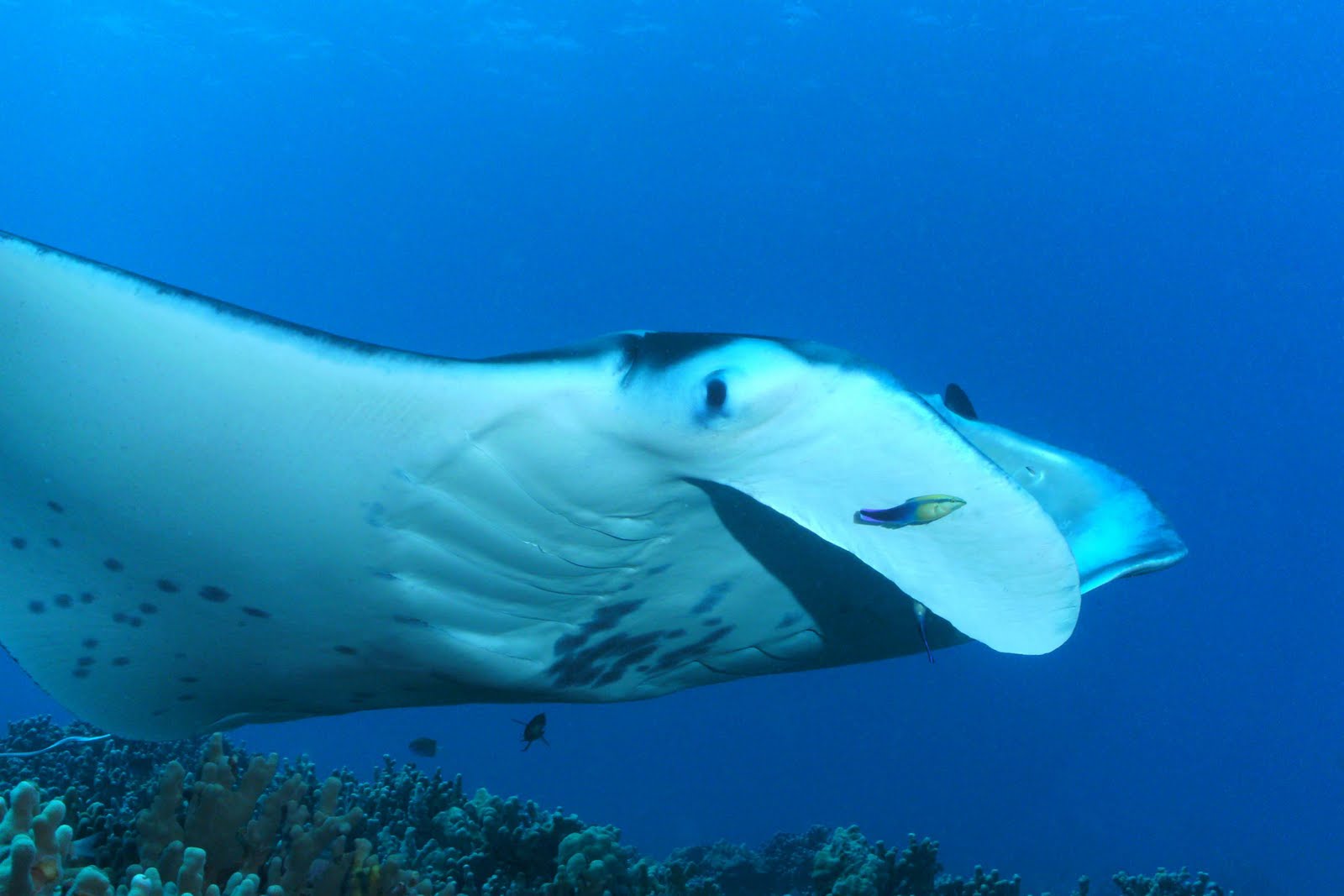
On Memorial Day, I ventured down to Keauhou Bay to see if I could find some mantas to swim with me. I was lucky and found two!  By far the more social of the pair was Kailey, the one pictured here. She remained very calm and collected as I settled into her orbit of the cleaning stations on the south side of the bay.

Photo Copyright 2013 by Barry Fackler
Kailey was named by the diver who first reported her existence to the Manta Pacific Research Foundation (MPRF). The great folks at MPRF identified her for me when I e-mailed them a photo. They do a wonderful job of monitoring the manta ray dive operations along the Kona Coast and have established guidelines for dive operators who offer Manta Night Dives. MPRF has also been instrumental in getting legislation passed to protect the resident manta rays of Hawai'i from fishing and capture for public aquaria.

Photo Copyright 2013 by Barry Fackler

Unfortunately, the ocean is an untamed environment and no organization can protect every manta from the countless hazards out there. Kailey is missing her entire left cephalic lobe. This is the fin-like extension that forms one of the manta's "horns". When unfurled, these lobes funnel plankton into the mouth during feeding. Fortunately, Kailey's injury is well-healed and she appears well nourished as well. Hopefully, she'll be around to delight divers and snorkelers for a long time to come.


Wednesday, March 6, 2013

The Manta's Shadow Part VI - the Festo Air Ray


The manta ray is acknowledged as having a very hydrodynamic body which makes it of interest to engineers who are looking to use biological models to improve the efficiency of their products. This is a video that has been out for several years now which shows a bio-mechanical manta ray balloon. The practical ramifications of this technology are beyond me but, aesthetically, this is a really cool video set to groovy New Age music and is relaxing to watch. Anyone who has ever been on the Manta Night Dive will appreciate how well this toy simulates the looping feeding pattern of a real-life manta ray. Enjoy!

Wednesday, July 18, 2012

The Manta's Shadow, Part V - The Batmobile!


This week, fanboys ( and, presumably, fangurlz) everywhere are eagerly awaiting the cinematic nerdfest known as The Dark Night Rises and the internet is abuzz with Batman news and opinions. In a shameless gambit to snare even one unwary web surfer to My Humble Blog, I present to you a tale of the Batmobile from the critically acclaimed and culturally relevent 1966-1967 TV series, Batman.


In 1966, I was an adorable 9-year old who loved comic books and was thrilled that a live-action TV series featuring the super-cool Batman was a becoming a reality. Unfortunately, even for an optimistic child, this show was a harsh reality. I kept watching every week, believing in my little heart that, surely, this mess would get better. Such was not the case. This incarnation of Batman was a buffoon not a hero. But I kept watching and watching. Soon , I found two Truly Cool things about the show: Catwoman (Julie Newmar version, please. Sorry Eartha.) and the Batmobile. In that order.

Now one would think a vehicle called the Batmobile would be inspired by a bat. But one would be wrong. Mistaken and incorrect to be sure. From whence sprung the inspiration for this menacing design ? From the manta ray, of course, old chum! (The title of the post provided a significant Bat-Clue!).

The vehicle in question started life about a decade earlier as the Lincoln Futura Show Car. A rolling embodiment of gaudy post-war euphoria and impracticality, the Futura was a one-off vehicle that was shown off at auto shows to give folks a glimpse of the bright future ahead of them (Pintos, Pacers and Chevettes being impossible for the 1950's mind to grasp). According to oobject.com the Futura was "originally designed by William M. Schmidt and his design team at the Lincoln Styling Department. It's rakish lines are said to have been inspired by the mako shark and the manta ray. Turns out, Bill Schmidt was a SCUBA diver back when diving was one of the most macho of activities.


These vintage photos show the Futura in it's pre-batiffied state. Personally, I don't see a lot of manta ray in the design, but I'm going to milk this angle for all it's worth. Did I mention that The Dark Night Rises opens at theaters everywhere on July 20th and that you can  pre-order tickets on-line as soon as you finish reading this post?


Just to assure you that I didn't dredge up the only manta reference on the net, I'd like to cite wikia.com which says "The body of the Futura was fabricated by Ghia of Italy whose artisans hammered the car's panels over logs and tree stumps to create the sleek manta ray-like car.


According to these websites the Futura was built for a cost of $250,000. That was a butt-load of money in those days and still is.

Sadly, the Futura experienced perhaps the highest rate of depreciation in automotive history. Custom car designer George Barris reportedly bought it for one dollar and had it sitting around his garage when the call came from ABC saying they needed a Batmobile for their upcoming series. Mr. Barris was planning to build a completely original design but ABC stipulated the car had to be ready in three weeks. Suddenly the Futura began to look sufficiently battish. In record time Barris and company made the bat-modifications, gave the car a killer paint job and an automotive legend was born. 


A theatrical footnote: The pre-bat Lincoln Futura was featured in the cinematic masterpiece It Started With a Kiss starring Debbie Reynolds (aka Princess Leia's MOM!) and Glenn Ford (Lincoln/Ford hmmmm). Here Ms. Reynolds demonstrates the future Batmobile's ability to multi-task as furniture.


Personal footnote: Lady in Red looks extremely hot even by today's standards but is most likely dead by now.

So stay tuned for the next episode of The Manta's Shadow on this Bat-Channel!

Sunday, January 9, 2011

The Manta's Shadow: Part II The War of the Worlds

 Aloha, and welcome to the second installment in a series of posts that examine the influence of manta ray shape, design or function in science and culture.


The image of a manta ray evokes a variety of responses from people. Many SCUBA divers appreciate the graceful fluidity of its movements as it seems to soar through the water. Technically inclined persons can admire the manta's hydrodynamic efficiency with a shape that minimizes turbulence and drag. To others, a manta seems to embody the mysterious and sinister, a dark and almost mythological creature of dread.

Today's subject is the 1953 film The War of the Worlds. This movie, an adaptation of the H.G. Wells classic novel, is considered a sci-fi classic and introduced what were (at the time) ground-breaking special effects. A central component of these effects were the Martian war machines designed by artistic director Albert Nozaki. In updating the story for a modern audience, Nozaki discarded Wells' mechanical tripods and re-imagined them as sleek, stealthy and sinister appearing...


...MANTA RAYS !


Just look at the thing! Even as a little kid watching this on Saturday Night at the Movies I could tell these were manta rays transformed into really cool-looking alien craft. For die-hard sci-fi purists, note that in the photo above, the faint green columns of "sparks" under the craft. Nozaki, faithful to the novel, had his machines walking on "tripods" of force rather than mechanical legs.

The Internet Movie Data Base states in its "Trivia" for War of the Worlds "Albert Nozaki based his designs of the Martian machines on the shape and movement of manta rays". While the shape may have sprung from an appreciation of aerodynamics, it is probably just as likely that the form was chosen because it evoked feelings of fear, foreboding and the unknown. To quote the website Roger's Rocketships "Their appearance was halfway between the current mysterious Flying Saucers that everyone was talking about and manta rays. Neither association was good. Flying saucers frightened people and manta rays were something people avoided because of their sting. And well they should!"


Divers out there will immediately protest that mantas have no stinger, but that's not the point (ha!). Even today, the majority of people think manta ray and stingray are synonymous. All the more so in the pre-Animal Planet early 1950's. Roger's observations accurately reflect the conventional wisdom  of the time as well as the film-maker's intentions. In the 50's mantas were scary.

The down-turned wing-tips add to the manta-like appearance as does the central green light positioned where a manta's mouth would be. Disrupting the manta-effect is the long "gooseneck" projection from whence came the "death ray" which reduced anything it touched to cinders (a stinger, if you like).

If you enjoy sci-fi (as I do) check out Roger's website at www.rogersrockets.com. He has a lot of info on spacecraft from classic science fiction films and you can even purchase schematics of the Martian war machine.

Mr. Nozaki's imaginary craft continues on even today. Sci-fi fans purchase and build models of what they like to call "manta ships" from that long-ago movie. And you can count on other sci-fi references coming up in future posts on The Manta's Shadow.

Sunday, September 12, 2010

Thursday Morning at Keauhou Bay

Photo Copyright 2010 by Barry Fackler


Last Thursday, I went to Keauhou Bay for a couple of dives. With winter swells not far off, I thought I'd take advantage of the low surf while I could. Getting in & out is a bit more difficult here than at Honaunau.
The payoff was to spend time with this medium-sized manta on both dives. She was a little stand-offish at first but eventually started doing some nice close passes. I mostly took photos of her by ambient light as there was a lot of particulate matter in the water column. Still a great time!
Photo Copyright 2010 by Barry Fackler

Photo Copyright 2010 by Barry Fackler

Photo Copyright 2010 by Barry Fackler 

Photo Copyright 2010 by Barry Fackler

Friday, May 7, 2010

Belated Weekend Dive Report for 5/02/10

This was a busy week and I just didn't have time to post until now. Last week I had a really great pair of dives in Keauhou Bay with lots of big animal contacts that I just hadn't been getting at Honaunau recently.


Photo Copyright 2010 by Barry Fackler

One thing that is almost a constant in Keauhou Bay is the "baitball". A huge swirling mass of what appears to be thousands of Bigeye Scad or akule. The location of the ball changes but it's always somewhere in the bay. My camera's wide angle lens can't capture the whole "baitball" but I took this photo as I descended through its "eye".

 Photo Copyright 2010 by Barry Fackler

At the bottom of the baitball it's almost as dark as night. Down there, big Greater Amberjacks cruise slowly waiting to make a quick lunge and pick off one of the akule.

Photo Copyright 2010 by Barry Fackler

Another thing you can almost always count on seeing at Keauhou Bay is Horned Helmet shells. They are usually half-buried in the sand, but I pulled this one out for a quick photo before replacing it in the sand.

Photo Copyright 2010 by Barry Fackler

I had very nice manta encounters on both dives and got a lot of photos. In these two, a big girl gets a thorough grooming by two Hawaiian Cleaner Wrasse. The Cleaning stations are perfect for good close-up photo opportunities.

Photo Copyright 2010 by Barry Fackler

Any encounter with  Mantas is a great experience and in Keauhou Bay they tend to linger in discrete areas for long periods of time.

Photo Copyright 2010 by Barry Fackler

This Crown-of-Thorns was creeping along the rubble bottom and wasn't threatening any coral at the moment.

Photo Copyright 2010 by Barry Fackler

This Amberjack came up to me and circled several times. I was far from the baitball and the jack seemed to be heading out to the deeper waters outside the bay. Maybe he had his fill of akule.

Photo Copyright 2010 by Barry Fackler

I had another jack encounter with this Bluefin Trevally or omilu. This one was on the smallish side and followed me around for a few minutes. Sometimes smaller predators like to follow around bigger predators hoping for a chance to snatch some scraps. Maybe this fish thought I was a big carnivore.

Photo Copyright 2010 by Barry Fackler

These fish are mostly silver but have really cool-looking, neon-bright blue fins which make them a real treat to see.

That's all the photos I have for now. Hopefully, I'll get in the water this weekend and take some more!      

Aloha


Tuesday, September 15, 2009

That Went Well!

Copyright 2009 by Barry Fackler

Well, I just viewed my first post and now I am filled with hubris over my ability to follow simple instructions! Anyway, before I call it a night, here is a close-up of a manta ray with a small Hawaiian cleaner wrasse giving it a once-over

Aloha, World

 
  Copyright 2009 by Barry Fackler

Aloha and welcome to my humble blog. I plan to post often about what it is like living on the Kona Coast of Hawaii's Big Island and SCUBA diving every weekend (almost). Along the way I'll keep you updated about general diving conditions and weather, local diving news, anecdotes from ten years of diving in Kona, and maybe some thoughts on life in general. I also hope to share my attempts at underwater photography, modest as they may be. It may take me some time to get the hang of blogging but I will give it my best shot!

Above is my first photo download to this blog. I'm pleased! This is a photo of a manta ray taken earlier this summer in Keauhou Bay. Kona is well known for it's manta night dives. These are somewhat orchestrated events where dive operators set up powerful lights on the seafloor. The lights attract zooplankton (just like lights on land attract bugs), which brings in the mantas which feed on the plankton. Divers sit on the bottom and get treated to a very close encounter with the giant rays. Occasionally they get shut out but not very often. Some nights over twenty mantas show up. I've been on plenty of manta night dives and they are worth the money, especially if you're on vacation. Personally, I prefer to go to Keauhou during the day where you have a pretty good chance of seeing mantas as they cruise around cleaning stations where small wrasse rid them of parasites and loose tissue. The advantages are: viewing and photographing in daylight as well as saving a lot of money by not taking a boat ride. The disadvantages are: climbing over jagged lava rock to make a shore entry and not having divemasters and boat crew to bail you out if you encounter trouble. I suppose if you're visiting, going out with a dive operator is the safest option and the one with the greatest chance of success. But if you live here, the shore entry is a nice way to have a big animal encounter with minimal cost.